
Cape Verde
Travelling to Cape Verde suits you if you want sun, sand and a relaxed African atmosphere – all year round. The archipelago lies off Africa’s west coast and offers chalk-white beaches, clear skies and good value.
When should you go? The high season runs from November to May, but the climate is dry and sunny all year, so you can safely plan a holiday at any time.
- ☀️ Guaranteed sunshine – 350+ sunny days a year
- 🏖️ Best islands: Sal and Boa Vista
- ✈️ Flight time: about 6 hours from Denmark
- 💶 Price level: cheap compared with southern Europe
Read on to find out which island in Cape Verde suits you, how to plan your trip, and what it costs in 2025-27.
Why travel to Cape Verde?
Cape Verde stands for unspoilt and incredible nature on an archipelago in the middle of the great Atlantic, some 570 km west of Senegal, Africa. The name means “green headland”.
The islands, of which there are 10 in total, bask happily in the sun just off the north-western coast of Africa in the wide Atlantic. It is a breathtaking island group with nine inhabited islands, boasting a colourful Creole blend of African and European cultures, which today brings a new wave of tourism and investment to the shores of Cape Verde.
Cape Verde, or Cabo Verde, officially the Republic of Cabo Verde, is an island nation spanning an archipelago of 10 volcanic islands in the central Atlantic. It forms part of the Macaronesia ecoregion together with the Azores, the Canary Islands, Madeira and the Savage Isles. In ancient times these islands were referred to as the “Islands of the Blessed” or “Fortunate Isles”. Lying 570 kilometres west of the Cape Verde peninsula off the coast of north-west Africa, the islands cover a combined area of just over 4,000 square kilometres (1,500 square miles).

The 10 islands
The distance from Africa is measured from Senegal, Gambia and Mauritania, and the islands form part of the so-called Macaronesia ecoregion. They lie between latitudes 14° and 18° N and longitudes 22° and 26° W. So grab your compass!
The country is a horseshoe-shaped cluster of ten islands (nine inhabited) and eight islets, covering an area of 4,033 km².
The islands are divided into two groups:
the Barlavento (windward) islands: Santo Antão, São Vicente, Santa Luzia, São Nicolau, Sal, Boa Vista and
the Sotavento (leeward) islands: Maio, Santiago, Fogo, Brava.
The largest island, both in size and population, is Santiago, which is home to the capital, Praia, the main urban centre of the archipelago.
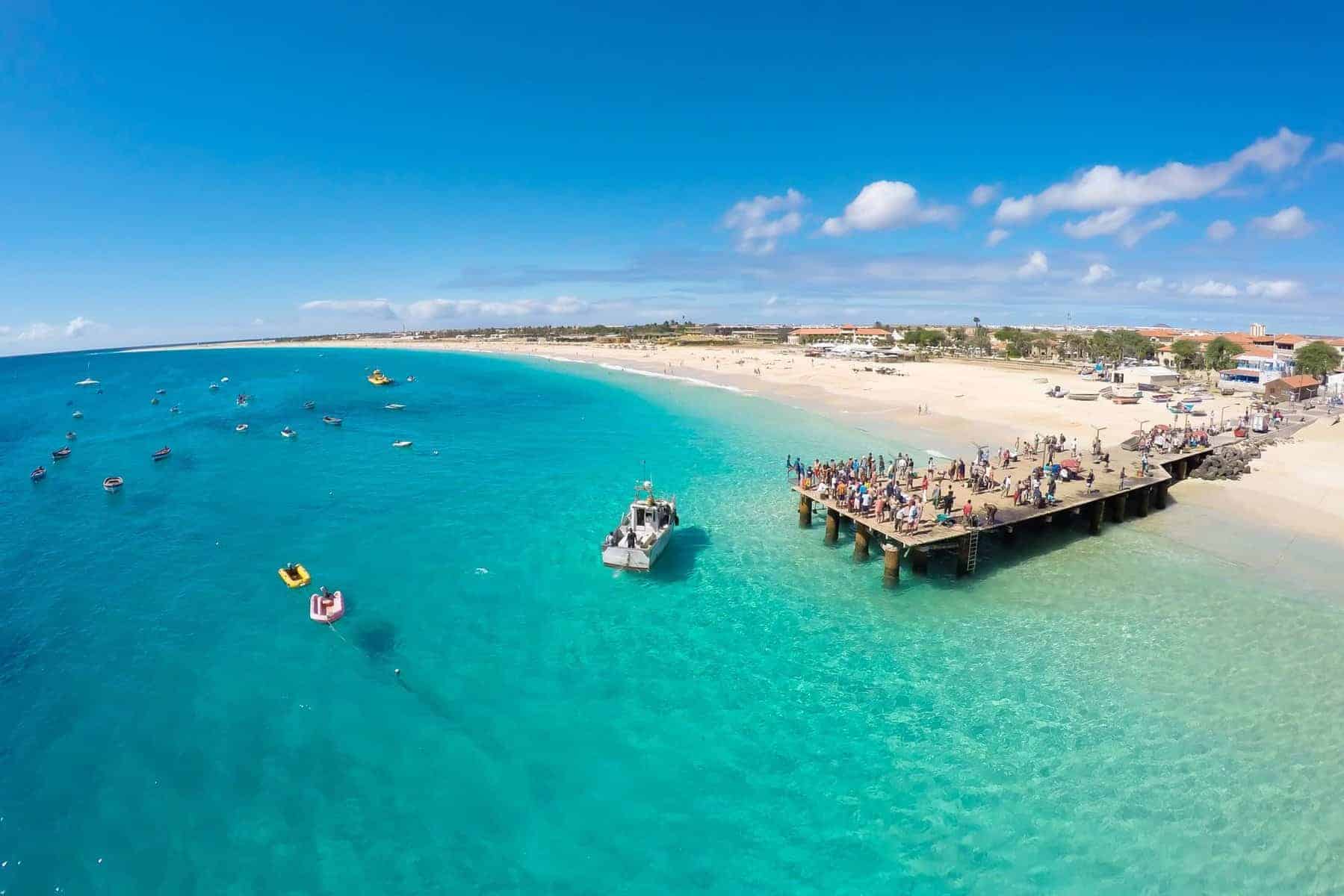
Three of the Cape Verde islands, Sal, Boa Vista and Maio, are fairly flat, sandy and arid. The others are generally more rocky with more vegetation.
How long does it take to fly to Cape Verde from Denmark?
The distance is around 5,470 kilometres, and the journey takes a good 7 hours from Copenhagen or Billund.
How to plan your trip to Cape Verde
- Choose your island – Sal or Boa Vista for a beach holiday, Santiago for culture.
- Check the season: November–May are the most popular months.
- Compare prices for package holidays and flights.
- Book your hotel well in advance – especially around Christmas and Easter.
Let the adventure begin
- Read our article on travelling to the Cape Verde islands
- What does a trip to Cape Verde cost?
- Africa as a travel destination – climate and culture


More articles on Cape Verde
Hvad koster rejsen til Kap Verde?
Hvad koster rejsen til Kap Verde i 2022? Det er et naturligt spørgsmål, også fordi det er ret nyt, man kan rejse til Kap Verde med en pakkerejse (al transport og hotel inkluderet) og fordi der er ret langt væk. Det har normalt også indflydelse på prisen. Modsat trækker det stadig moderate prisniveau på øerne. …
Rejser til Kap Verde – Oplev de 10 eksotiske øer i Atlanterhavet
Rejser til Kap Verde og de grønneste øer i Atlanterhavet Rejser til Kap Verde, også kendt som Cap Verde (grøn), der basker i solen lige ved den nordvestlige kyst af Afrika i det store Atlanterhav, er besøg i betagende øhav med ni beboede øer, der kan prale af en farverig kreolsk blanding af afrikanske og…


Practical travel information for Cape Verde
🛂 Visas and entry
- Visa: Danish citizens are visa-free (EU countries are exempt from Cape Verde’s visa requirements).
- EASE: In return, all travellers over 2 years of age must register on the mandatory EASE platform no later than 5 days before departure – and pay an airport security fee (TSA) of typically around 30 EUR.
- Passport: valid for at least 6 months.
💰 Currency and money
- Currency: Cape Verdean escudo (CVE), pegged to the euro – and the euro is accepted in many places on the tourist islands.
- Payment: cards are accepted at hotels and in towns; carry cash for taxis, markets and the smaller islands.
- Tipping: appreciated, but not expected.
🚗 Transport, time and health
- Flight time from Denmark: about 6–7 hours (direct charter flights to Sal and Boa Vista).
- Getting around: domestic flights and ferries between the islands; each island has its own character.
- Best time to travel: a year-round destination with pleasant weather; November–June is driest.
- Time zone: 2 hours behind Danish winter time.
- Languages: Portuguese and Cape Verdean Creole.
- Health: no compulsory vaccinations; drink bottled water.
- Safety: follow the Danish Ministry of Foreign Affairs travel advice.
When is the best time to visit Cape Verde?
Cape Verde has a dry, sunny climate for much of the year, but the weather is not identical from one month to the next. The cooler and drier season runs from roughly November to May, when the trade winds keep temperatures comfortable and humidity low. This is the period most visitors choose, and it is also when hotels on the popular islands tend to be fullest.
From about June to October the air grows warmer and more humid, and the wind can be strong on the exposed islands. Rain is rare throughout the year, but when it does fall, it usually comes in short, heavy bursts in late summer and early autumn. Those months are quieter and sometimes better value, though the sea is at its warmest and the light is still very good.
The inconvenient part is the wind. On the flatter, sandier islands it can blow hard for days at a time, which suits kitesurfers and windsurfers but makes sunbathing on an open beach less pleasant. If calm water and still air matter more to you than anything else, check the forecast for your island before you book, and bring a light layer for evenings, which can be cooler than the afternoons suggest.
Getting around the islands
Moving between the islands is one of the first practical decisions you will face, and the options vary a good deal. Inter-island ferries run on some routes, most notably between the larger islands in the Barlavento and Sotavento groups, but schedules change, crossings can be rough, and sailings are sometimes cancelled in bad weather. Domestic flights are quicker and are the usual choice for longer hops, though seats are limited and it is wise to book well ahead.
Within an island, taxis are the most common way to get around. They are not metered as a rule, so agree the fare with the driver before you set off. Hotels and airports can usually arrange a car for the day, which is often the simplest option for reaching beaches and villages away from the main road.
Hiring a car gives you the most freedom, particularly on Santiago, Santo Antão and Fogo, where the roads climb steeply and some tracks are unpaved. Driving is on the right, but road conditions and signage can be unpredictable, so an experienced driver and a sturdy vehicle are advisable. On the flat, sandy islands, a standard car is generally enough, though sand on the road can catch out the unwary.
Where to stay
Accommodation falls into a few broad types. Large all-inclusive resorts are concentrated on the sandy islands, where most of the purpose-built tourism sits. They offer beachfront pools, organised activities and predictable standards, but they can feel detached from the surrounding country. Smaller hotels and boutique properties are increasingly common and are often a better way to meet local life.
Guesthouses, known locally as pensões and residenciais, are the traditional option in the towns and villages. They are simpler, usually family-run and generally inexpensive, and they suit travellers who want to stay close to daily life. Standards vary, so it is worth checking recent reviews and asking about hot water and air conditioning before you book.
For a beach holiday, Sal and Boa Vista are the obvious choices, with the best-known resort areas and wide, sheltered sands. Santiago suits those who want culture, with the capital Praia and easy access to the old town of Cidade Velha. Santo Antão is the place for walkers who prefer mountain villages to the sea, while Fogo and Brava attract visitors looking for quiet and dramatic scenery, with fewer hotels and a slower pace.
Food and drink
Cape Verdean cooking draws on African, Portuguese and Atlantic influences, and it is generally simple, hearty and built around what is locally available. The national dish is cachupa, a slow-cooked stew of maize, beans and whatever meat or fish is at hand. It is often eaten at lunchtime, and the best versions are found in family restaurants and small local eateries rather than hotel buffets. Many islands have their own variation.
Fish is central to the diet, especially on the coastal islands. Grilled tuna, octopus and lobster appear on many menus, usually served with rice, cassava or fried plantain. Seafood is cheapest and freshest at small harbourside restaurants, where you can often choose your catch from the day’s landings. Goat and pork dishes are also common in the interior.
To drink, Cape Verdean grog, a sugarcane spirit flavoured with lime, honey or fruit, is the local favourite and can be strong. Local beers are widely available and cold, and imported wine appears in the tourist areas. Coffee, grown on the island of Fogo, is worth trying. Restaurants in Praia and on Sal and Boa Vista offer the widest choice, while the smaller villages keep to simpler menus.
What does a holiday cost?
Cape Verde is generally good value compared with much of southern Europe, but prices depend heavily on the island and the style of trip. Accommodation is the largest variable. Simple guesthouses can be found for well under 50 euros a night, mid-range hotels commonly fall between about 60 and 120 euros a night, and large resorts on Sal and Boa Vista cost more, especially in high season. Rates are usually quoted per room rather than per person.
Eating out is inexpensive if you choose local restaurants. A simple lunch of cachupa or fish at a family eatery often costs only a few euros, while a meal in a tourist restaurant or hotel can cost several times as much. Imported drinks and wine are pricier than local beer and grog.
Transport costs vary with how you travel. Taxi fares within an island are modest for short trips but add up on longer journeys, and fares are not fixed, so agree them in advance. Domestic flights cost more than ferries, and hiring a car for a few days is a significant expense but gives the most flexibility. Prices change, so check current rates with your provider before setting a budget.