
Rubjerg Knude, a scenic place formed millions of years ago
Rubjerg Knude is one of Denmark's most well-known natural icons.
Many of us often spend our holidays looking south. Airports and highways are packed with people and cars, all looking to get away from the Danish countryside for a few weeks and returning with their travel bags full of souvenirs, good memories and photos of incomparable nature from foreign climes. However, many forget on the move, on their way away from the cold north, that the small but lovely Danish country contains enough natural gems and experiences to fill the summer holiday calendar. Those who have visited Rubjerg Knude, for example, know this.
Raw natural power
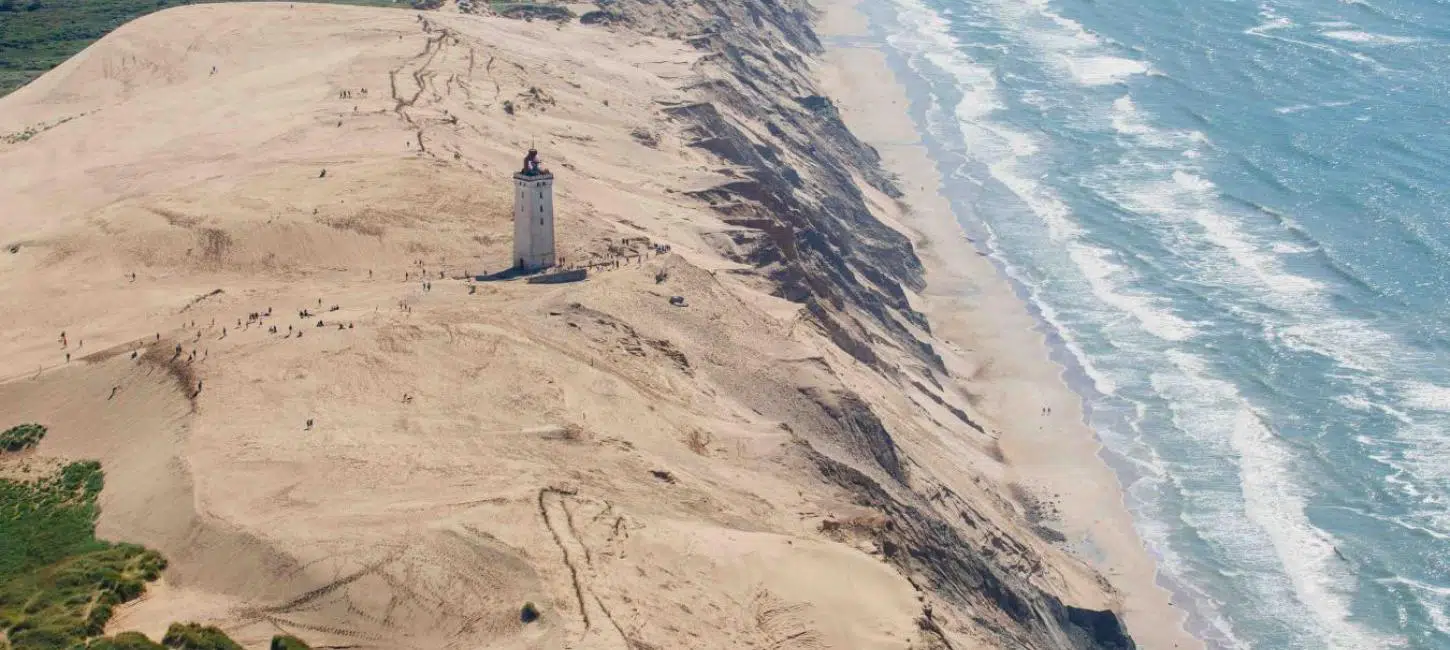
Rubjerg Knude is located on the west coast of Jutland between the popular holiday destinations of Løkken and Lønstrup. Even from a distance, the area is breathtaking with the light sand dunes that lie like a protective wall between the green, calm field landscape and the foaming waves of the roaring North Sea. When you arrive at Rubjerg Knude, you first encounter the plantation area and the green sand dune, which is full of sea buckthorn and elder. Here you will also find Rubjerg Gl. Church, where one tombstone in particular stands out. Not so much because of the deceased, but rather because of the date of death in 1877: April 31, which does not exist (count it yourself). According to legend, the stonemason would not change the date without demanding an extra payment of two kroner. The family did not agree to this and so it was that Willum Hansen received this very special memorial stone.
The lighthouse in the dunes
You can see it immediately as you approach Rubjerg Knude: Rubjerg Knude Lighthouse, standing upright in the blowing sand dunes. The lighthouse, which was first lit on December 27, 1900, consisted of a number of buildings in addition to the 23-meter-high tower. Here, among other things, there was a lighthouse keeper's residence, a gasworks with an associated tank, as well as a well and a garden area. Rubjerg Knude Lighthouse was built 200 meters inland on a dune 60 meters above sea level, but as the years passed, the violent sand drift resulted in the dunes moving closer to the lighthouse. Despite many repairs, planting of sedge and the construction of walls, all of which were intended to protect the lighthouse from the sand drift, the battle against harsh nature had to be given up in the end and on August 1, 1968, the light in Rubjerg Knude Lighthouse was lit for the last time. The lighthouse's lens, which was produced in France and cost 42.000 kroner, was taken out of the lighthouse and is now buried somewhere in the sand dunes.
Experience it before it's too late
A few years after the lighthouse was closed, a museum of sand drift was opened in the buildings. However, in 2002, this museum had to move the exhibition to Strandfogedgården, which is two kilometers from the lighthouse, because the violent sand drift was now destroying large parts of the lighthouse buildings. Today, Rubjerg Knude Lighthouse is only about 60 meters from falling down the steep cliff and into the roaring North Sea. The lighthouse, which started out 200 meters from the edge of the cliff about 116 years ago, will have fallen into the sea within two decades if it is not demolished first. Rubjerg Knude and its lighthouse are a piece of Danish history that will soon pass away. A battle between people and merciless nature. A battle that must be experienced before it is too late.
See also magnificent Northeast Jutland
The most beautiful places in Denmark?
13 Most Beautiful Places in Denmark for Your Dream Vacation Denmark, the land of Vikings, fairy tales and Lego, is becoming an increasingly popular tourist destination on a global scale. Known for its excellent culinary scene, cycling culture and the concept of 'hygge', Denmark is often voted one of the happiest nations in the world.
Netherlands as a travel destination
Netherlands as a travel destination
Denmark's national parks, see all 5 of them
🎬 Watch the journey on film — 365 ways to travel the world Watch our film →