
The city that survived being forgotten
Hoi An is the best-preserved trading town in Southeast Asia, and the reason is less romantic than you might think: the river silted up. In the 1800th century, the mouth of the Thu Bon River became too shallow for the big ships, trade moved to Da Nang, and Hoi An quietly languished for a hundred years. No one tore anything down to build new ones because there was no money to build new ones.
Then came the war, and Hoi An escaped almost unscathed, while Hue to the north was razed to the ground. When UNESCO put the city on the World Heritage List in 1999, it was a place where two rounds of history had passed by.
The city is located 30 kilometers south of Da Nang — about a 45-minute drive — and a good 800 kilometers north of Ho Chi Minh City. It's worth clearing up that confusion right away: Hoi An belongs to Central Vietnam and is planned together with Da Nang and Hue, not with the south.
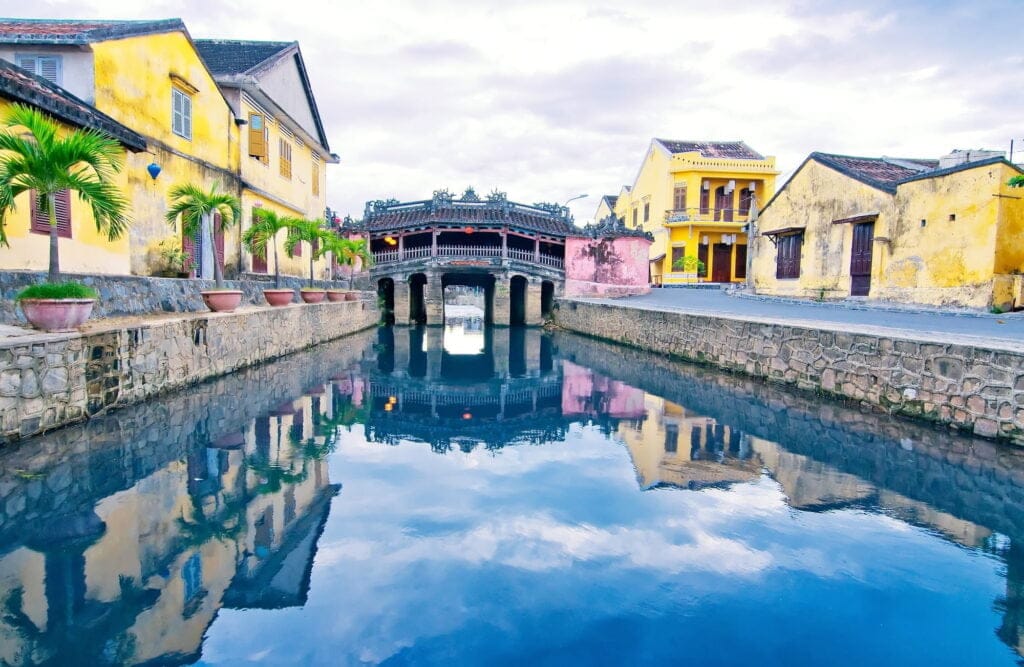
The Old Town: 2 square kilometers of four cultures
Hoi An was the meeting place for Japanese, Chinese, Indian, Portuguese and Dutch merchants from the 1400th century, who lay here waiting for the monsoon to return so they could sail home. Some of them waited for months. That is why the city has permanent architecture from four cultures and not just warehouses.
The old town is only about two square kilometers and can be walked in a morning. Yellow French facades stand squarely next to dark red Chinese community halls and Japanese wooden buildings with low, wide eaves.
The landmark is Chùa Cầu , the late 1500th-century Japanese covered bridge, built by the Japanese merchant colony to connect their neighborhood with the Chinese. It is so central to the city’s identity that it appears on the Vietnamese 20.000-dong note. The bridge underwent a major restoration, completed in 2024, and the result was hotly debated in Vietnam — many thought it had become too pretty. It’s worth knowing the history before you see it: it looks new because it has.
Practical information about the ticket: admission to the old town is sold as a combined ticket for around 120.000 dong, which gives access to five of the approximately twenty-two listed houses, community centers and museums. You don't need to buy it to walk the streets, but you do need it to enter the buildings — and it's inside the buildings that the city gets interesting.
The lanterns — and when they are actually lit
The Full Moon Party is the night everyone has seen pictures of: the streets are closed to motorized traffic, the electric lights are dimmed, and silk lanterns are lit throughout the district, while paper candles are set out on the river.
It's not an annual event. It's held on the fourteenth day of each lunar month , so about once a month year-round. That makes it easy to plan for — and worth planning for, because there's a real difference between Hoi An that night and Hoi An on a regular Wednesday.
Note, however, that the lanterns hang and light up every single night. You don't miss the city by avoiding the full moon; you miss one particular night.
The tailors, and what you need to know before you go in
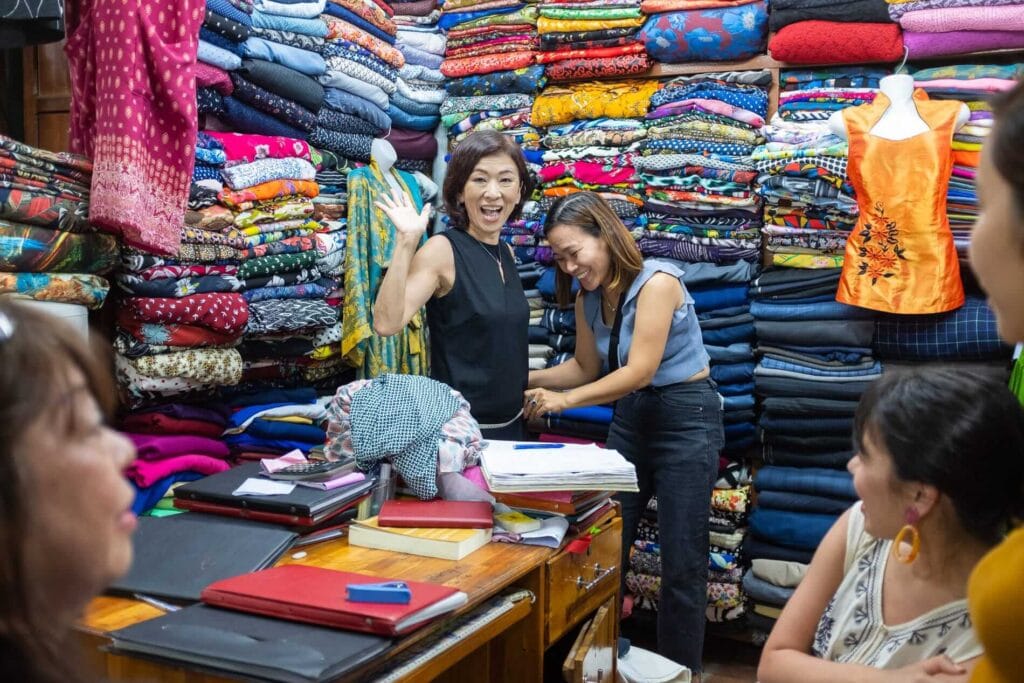
The city has hundreds of tailors, and the tradition of having clothes made in a day is genuine. However, the quality varies wildly, and this is where most travelers are disappointed.
The established houses — Yaly Couture and A Dong Silk are the two names most often mentioned — have their own sewing rooms and take proper measurements. Further down the price range, the work is sent out of the house, and then a day becomes a guessing game.
Three pieces of advice if you want to succeed:
- Come on the first day, not the last. There should be time for at least one fitting, and preferably two. A suit that hasn't been tried on is a suit that doesn't fit.
- Bring a picture of something you own and like. Descriptions get lost in translation; a cutaway shape doesn't.
- Ask about the fabric. “Silk” covers a lot, and the price difference between real silk and a blend is real.
The real benefit isn't the clothes. It's standing in a workshop where someone has been doing the same thing for forty years, and seeing how quickly things go when you know your job.
My Son: The Champa temples in the interior
Forty kilometers west of Hoi An lies My Son , a sanctuary complex built by the Champa kingdom between the 400th and 1300th centuries and included on the UNESCO list the same year as Hoi An.
You have to know what you're getting into. My Son is not Angkor Wat — it's smaller, and it's damaged. During the war, the area was bombed because it was used as a shelter, and several of the main towers were destroyed. Some of the craters are still there between the temples.
It makes the place more poignant, not less. The red bricks are put together without visible adhesive, using a technique that no one today has been able to fully reconstruct, and the faces of the reliefs are still sharp after a thousand years in a tropical climate.
Leave at five in the morning. Not because of the light, but because the buses from Hoi An arrive at eight, and because the midday heat in a valley without shade is relentless.
The food — and the dish that can only be found here
Hoi An is the city in Vietnam where it is best to eat your way through the day rather than eating meals.
Cao lầu is the city’s signature dish and is virtually found nowhere else: thick, yellowish noodles with slices of pork, fresh herbs and crispy noodle chips, with only a tiny bit of stock at the bottom of the bowl. Tradition has it that the noodles are made with water from the Bá Lễ well and ash from trees on the Cham Islands — which is part of the reason the dish doesn’t travel.
Bánh mì is the other. Bánh Mì Phượng became world-famous after Anthony Bourdain filmed there, and the line outside reflects that. Madame Khánh — “the Banh Mi Queen” — makes a different and, in many people’s opinion, better version a few blocks away. Both cost a pittance.
And then there are white roses , bánh bao bánh vạc , steamed rice flour dumplings shaped like flowers, which are reportedly made by a single family in the city and distributed to the restaurants.
If you want to take the technique home, several restaurants hold cooking classes that begin with shopping at the market at 7 a.m. We've gathered the rest of the country's cuisine in 21 Vietnamese dishes and where they belong.
Where to stay
Located on Ha My Beach, about a 20-minute drive north of the city, Four Seasons Resort The Nam Hai features ocean-facing pools and villas in low-rise, Vietnamese-inspired architecture. It's a place where the beach and distance from the streets are the point.
If you want to be able to walk straight into the old town, the smaller boutique hotels inside the city are the right choice — Almanity Hoi An and Hoi An Historic Hotel are among the well-known ones. The difference is real: if you stay out on the beach, you don't see the city early in the morning, and that's where it's at its best.
If you stay overnight in Da Nang instead, you're 45 minutes away and miss out on the evening. This is the most common planning mistake on the entire central coast.
When to travel — and when not to
February to May is the best period: 25–30 degrees, low humidity and only rare rain.
September to December should be taken seriously. It’s not just the rainy season — Hoi An floods regularly because the old town is low-lying on the river. The streets can be submerged for days, and shops have water level markers painted on the walls inside. The town is used to it and doesn’t close, but this isn’t the trip you booked.
June to August is hot and dry, but also peak season for domestic tourists.
Further on the route
Hoi An is located in the middle of Central Vietnam, and everything the city has to offer is within two hours. The Golden Bridge in the Ba Na Mountains lies above Da Nang, and to the north the road goes over the Hai Van Pass to the imperial city of Hue. Further north again lie the caves of Phong Nha and Ha Long Bay , and at the other end of the country Ho Chi Minh City.
The entire process from north to south is part of our introduction to Vietnam as a travel destination.
🎬 Watch the journey on film — 365 ways to travel the world Watch our film →